


From a busy restaurant in Houston to a neighborhood café in Chicago, a hotel kitchen in Miami, or a large food-service facility in Los Angeles, commercial businesses across the United States have one thing in common:
Cleanliness is part of the operation.
Commercial cleaning has evolved far beyond simply emptying trash cans and wiping down floors. Today, businesses rely on specialized cleaning services to maintain kitchens, restaurants, cafés, commercial buildings, sidewalks, parking areas, loading zones, and exterior surfaces.
And because every business environment is different, commercial cleaning companies across the country have developed different specialties, techniques, equipment, and service models.
For restaurants and food-service businesses in particular, three services deserve special attention:
Commercial kitchen cleaning.
Hood and vent cleaning.
Commercial power washing.
Together, these services can help businesses maintain cleaner, safer, more professional facilities.
Commercial Cleaning Looks Different in Every City
The United States is a huge and diverse market.
A commercial cleaning company working in Houston may regularly deal with hot weather, humidity, large restaurant facilities, outdoor grease buildup, and expansive commercial properties.
In New York, companies may work with high-density restaurants, apartment buildings, retail locations, and facilities where access and scheduling can be challenging.
In Chicago, winter weather can create additional demands for exterior maintenance.
In Florida, humidity, storms, mold-prone environments, and outdoor surfaces can influence cleaning requirements.
In California, businesses may place greater emphasis on water-conscious cleaning practices and environmental considerations.
In every region, the fundamentals of professional cleaning remain important but the environment, building, business type, local requirements, and cleaning challenges can vary significantly.
That’s why commercial cleaning is not a one-size-fits-all industry.
The Growth of Specialized Commercial Cleaning
Commercial cleaning has become increasingly specialized.
Instead of one company trying to do everything with the same equipment and process, many providers focus on particular services.
Some specialize in:
- Office cleaning
- Restaurant cleaning
- Commercial kitchen deep cleaning
- Hood and exhaust cleaning
- Floor care
- Carpet cleaning
- Window cleaning
- Pressure washing
- Parking-lot cleaning
- Building exterior cleaning
- Healthcare cleaning
- Industrial cleaning
- Warehouse cleaning
- Hotel and hospitality cleaning
This specialization matters because different environments require different knowledge.
A restaurant kitchen covered in grease cannot be cleaned the same way as an office.
A concrete parking lot cannot be treated the same way as a delicate interior floor.
A commercial exhaust system cannot be cleaned properly simply by wiping the visible hood.
Professional commercial cleaning begins with understanding what is being cleaned and what the facility actually needs.
Commercial Kitchen Cleaning: More Than Making a Kitchen Look Clean
Commercial kitchens operate under demanding conditions.
Every day, restaurants and food-service businesses deal with:
- Grease
- Oil
- Food particles
- Smoke
- Heat
- Spills
- Heavy foot traffic
- Moisture
- Equipment buildup
Routine employee cleaning is essential, but it is not always enough to address the deeper buildup that develops over time.
That’s where professional commercial kitchen cleaning becomes important.
A thorough cleaning program can address areas such as cooking equipment, floors, walls, hard-to-reach surfaces, areas around and underneath equipment, grease accumulation, and other parts of the kitchen that may not receive enough attention during a busy service schedule.
The objective is not simply to make the kitchen look good.
It is to help create a cleaner, better-maintained working environment.
Hood and Vent Cleaning: One of the Most Important Specialized Services
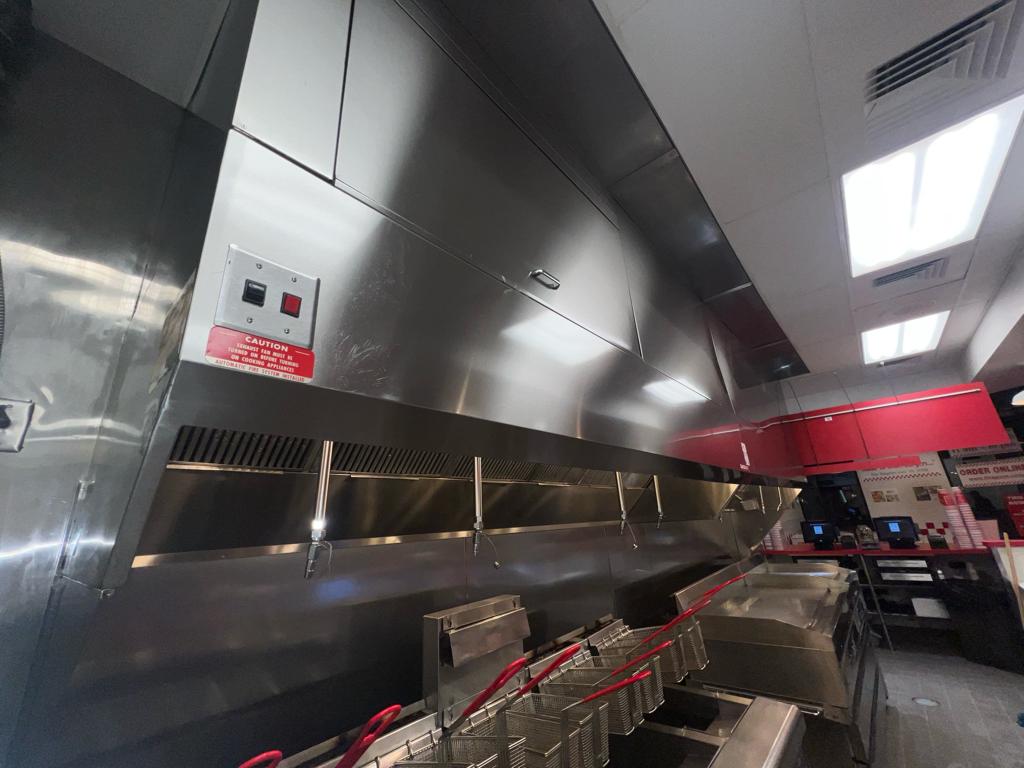
Commercial cooking produces grease-laden vapors.
Those vapors travel through the kitchen exhaust system and can deposit grease inside the hood, filters, ducts, fans, and other components.
This is why commercial kitchen exhaust cleaning is a specialized service.
NFPA 96, the Standard for Ventilation Control and Fire Protection of Commercial Cooking Operations, addresses inspection and cleaning of commercial cooking exhaust systems. Its current provisions call for inspection schedules based on cooking type and volume, with contaminated portions cleaned by appropriately trained and qualified personnel acceptable to the authority having jurisdiction. (NFPA LiNK)
The important point for restaurant owners is simple:
Hood cleaning is not necessarily just hood-surface cleaning.
A complete exhaust system can involve the hood, grease-removal devices, ductwork, fans, and other components.
Industry guidance from IKECA specifically distinguishes full-system kitchen exhaust cleaning from services that simply clean the visible hood and filters. (IKECA)
That distinction can make a significant difference.
Grease is more than an unpleasant-looking substance.
When combustible grease accumulates inside an exhaust system, it can become a fire-safety concern.
That is why NFPA 96 addresses the removal of combustible contaminants before surfaces become heavily contaminated with grease or oily sludge. (NFPA LiNK)
For restaurant owners, the takeaway is straightforward:
Don’t wait until the exhaust system looks heavily contaminated before thinking about maintenance.
A recurring inspection and cleaning program is a much better approach.
Commercial Power Washing: Cleaning Beyond the Kitchen
Commercial cleaning doesn’t stop at the back door.
The exterior of a business is often the first thing customers see.
Think about walking toward a restaurant.
Before entering, customers see:
- Sidewalks
- Entrances
- Concrete
- Parking areas
- Driveways
- Building walls
- Dumpster areas
- Loading zones
- Patios
- Outdoor dining areas
Over time, these surfaces can collect dirt, grease, food residue, tire marks, oil, algae, mildew, and other buildup.
This is where commercial power washing can make a major difference.
Why Restaurants Need Exterior Cleaning
Restaurant properties can experience particularly challenging exterior conditions.
Grease can travel from kitchen operations toward exterior service areas.
Trash and recycling areas can develop stains.
Outdoor dining areas experience constant customer traffic.
Sidewalks can accumulate dirt and organic growth.
Parking lots can develop oil and vehicle stains.
A professional pressure-washing or power-washing service can help restore these surfaces and create a cleaner, more professional appearance.
And appearance matters.
A customer may never see the restaurant’s kitchen exhaust system.
But they will almost certainly see the front entrance.
First Impressions Start Outside
A restaurant can have excellent food and outstanding service.
But imagine arriving at the property and seeing:
A dirty sidewalk.
Greasy concrete.
Stained entrance areas.
A neglected patio.
Dirty walls.
An unattractive dumpster area.
That first impression can influence how customers perceive the entire business.
Commercial power washing can therefore be more than cosmetic maintenance.
It can become part of a business’s brand presentation and property-maintenance strategy.
Houston and the Importance of Commercial Cleaning
Houston is particularly interesting for commercial cleaning because of the scale and diversity of its business environment.
The city has restaurants, cafés, hotels, catering operations, medical facilities, retail properties, office buildings, warehouses, and other commercial facilities operating throughout the metropolitan area.
Businesses also have to deal with Houston’s climate and outdoor conditions.
Heat, humidity, rain, dust, traffic, and organic growth can all affect exterior surfaces.
For restaurants, that means cleaning may need to happen both inside and outside.
A kitchen may need deep cleaning and hood maintenance while the exterior needs concrete cleaning, sidewalk washing, patio cleaning, or building washing.
A comprehensive commercial cleaning strategy considers the entire property.
Why Every Business Needs a Different Cleaning Plan
There is no universal cleaning schedule that works perfectly for every business.
Consider three businesses:
A café may have a smaller cooking operation, customer-facing counters, floors, windows, restrooms, and outdoor areas.
A busy restaurant may have fryers, grills, ovens, large exhaust systems, heavy grease production, extensive flooring, and high customer traffic.
A Hotel or Institutional Kitchen
A hotel, hospital, school, or large institutional kitchen may operate on an entirely different scale and require more complex scheduling and coordination.
The cleaning requirements are different.
That’s why a professional provider should evaluate the facility rather than simply selling the same package to everyone.
The Right Commercial Cleaning Company Matters
Choosing a commercial cleaning company should not be based solely on price.
Restaurant owners and facility managers should consider:
Experience: Does the company understand commercial environments?
Specialization: Does it have experience with kitchens, exhaust systems, or exterior cleaning?
Equipment: Does it use equipment appropriate for the job?
Scheduling: Can it work around the business’s operating hours?
Safety: Does it have procedures for protecting employees, equipment, surfaces, and the facility?
Documentation: Can it provide appropriate service records?
Consistency: Can it support a recurring maintenance schedule?
Local knowledge: Does it understand the market and operating environment in the area where it works?
These questions can help separate a professional commercial cleaning provider from a basic general cleaning service.
Cleaning Companies Across America Are Becoming More Specialized
One of the most interesting developments in the industry is specialization.
Businesses increasingly need cleaning companies that understand specific environments.
A restaurant doesn’t necessarily need the same provider or the same process as an office.
A warehouse has different requirements from a medical facility.
A commercial kitchen has completely different challenges from a retail storefront.
And an exterior concrete surface requires different equipment and techniques from an interior floor.
This specialization is one reason commercial cleaning companies can be found in virtually every major U.S. market, with providers developing expertise around the needs of their local businesses.
The best companies aren’t simply selling “cleaning.”
They’re selling solutions to specific maintenance problems.
Technology and Professional Cleaning
Modern commercial cleaning is also becoming more organized and technology-driven.
Scheduling software, digital inspections, service documentation, equipment innovations, photographs, reporting systems, and other technologies can help cleaning companies deliver more consistent services.
For commercial customers, this can provide something extremely valuable:
accountability.
A restaurant manager should be able to understand when a service was completed and what work was performed.
A facility manager should be able to plan future maintenance.
A property owner should be able to maintain records.
The industry is moving toward a model where professional cleaning is increasingly treated as a measurable part of facility management.
The Future of Commercial Cleaning
The future of commercial cleaning will not simply be about having more cleaning companies.
It will be about having better specialized services.
Businesses are becoming more aware of the importance of:
- Preventive maintenance
- Hygiene
- Fire-safety considerations
- Professional appearance
- Customer experience
- Equipment maintenance
- Exterior property care
- Sustainability
- Service documentation
- Recurring cleaning schedules
For restaurants and food-service businesses, commercial kitchen cleaning and hood and exhaust maintenance remain particularly important.
For property owners, power washing and exterior maintenance can help preserve the appearance of commercial properties.
And for customers, all of these things contribute to one simple expectation:
They want to walk into a business that feels clean, professional, and well cared for.
Choosing a Commercial Cleaning Partner
Whether a business operates in Houston, Dallas, Atlanta, Miami, Chicago, Los Angeles, New York, or another U.S. market, choosing the right commercial cleaning partner is an important business decision.
The right company should understand the facility, identify its specific cleaning challenges, recommend an appropriate maintenance schedule, and use the right techniques for each job.
For Houston-area businesses, Cornerstone Commercial Services offers commercial cleaning solutions that include commercial kitchen cleaning, hood and vent cleaning, and power washing.
The larger lesson, however, applies across the country:
Commercial cleaning is not one service. It is an entire category of specialized services designed around the needs of different businesses and environments.
From the kitchen hood to the rooftop exhaust fan, from the restaurant floor to the sidewalk outside, every part of a commercial property contributes to how a business operates and how customers experience it.
And in today’s competitive business environment, keeping that entire property clean isn’t just about appearance.
It’s part of running a professional business.

Comments are closed