


Walk into almost any restaurant or café in Houston today and you will probably notice something different about the way customers choose where to eat.
They are not just looking at the menu anymore.
They are checking Google reviews. They are looking at photos. They are reading comments. They are searching social media. They are paying attention to what other customers say about cleanliness, bathrooms, tables, odors, kitchens, service, and the overall condition of the establishment.
In other words, restaurant and café hygiene has become part of the customer experience and customers are paying attention.
For restaurants, cafés, bakeries, food trucks, catering businesses, hotels, and commercial kitchens across the Houston area, maintaining a clean facility is no longer something that can be treated as an occasional chore.
It is an essential part of protecting customers, employees, reputation, equipment, and the business itself.
Houston’s Restaurant Industry Is Under a Microscope
Houston has an enormous and diverse food-service industry.
From neighborhood cafés and coffee shops to fine-dining restaurants, fast-casual establishments, bakeries, food halls, catering kitchens, hotels, and large commercial food operations, thousands of businesses prepare and serve food every day.
The scale of Houston’s food-safety oversight reflects the size of the industry.
The Houston Health Department’s Food Safety Inspection program covers restaurants and many other food establishments, including grocery stores, specialized food establishments, mobile food units, wholesale food establishments, and catering businesses. The city’s FY2026 budget documents targeted more than 38,000 food facility inspections for the year.
That means cleanliness is not merely a matter of whether a restaurant looks presentable when customers walk through the front door.
Commercial food establishments operate in an environment where sanitation, food handling, equipment cleanliness, employee practices, and facility conditions can all matter during inspections.
Today’s Customers Check Before They Eat
There was a time when customers might simply choose a restaurant based on location, price, menu, or word of mouth.
Today, the decision often begins online.
A customer may search:
“Best restaurants near me.”
Then comes the next step:
“Is it clean?”
They may look through photographs.
They may read recent reviews.
They may search for comments about dirty bathrooms, sticky tables, unpleasant smells, insects, poorly maintained dining areas, or visible kitchen problems.
Younger consumers in particular have grown up with immediate access to information and reviews. A restaurant’s reputation can be influenced by a single photograph or a handful of negative experiences shared publicly.
That makes cleanliness more than an internal operational issue.
It becomes part of the restaurant’s online reputation.
A restaurant can spend thousands of dollars on advertising, branding, social media, photography, and customer acquisition—and still lose potential customers because someone sees repeated complaints about cleanliness.
A Clean Dining Room Is Only Part of the Picture
One of the biggest misconceptions about restaurant cleaning is that visible cleanliness means the entire facility is clean.
It doesn’t.
A dining room can look excellent while grease and residue are accumulating in areas customers never see.
Commercial kitchens contain numerous locations that require specialized cleaning:
- Cooking equipment
- Exhaust hoods
- Hood filters
- Ventilation components
- Grease-affected surfaces
- Floors and grout
- Walls surrounding cooking equipment
- Areas underneath and behind equipment
- Drains
- Storage areas
- High and difficult-to-reach surfaces
- Waste and service areas
These areas can experience much heavier contamination than an ordinary residential environment.
That is why professional commercial kitchen cleaning requires specialized knowledge, equipment, procedures, and scheduling.
Why Hood and Vent Cleaning Deserves Special Attention
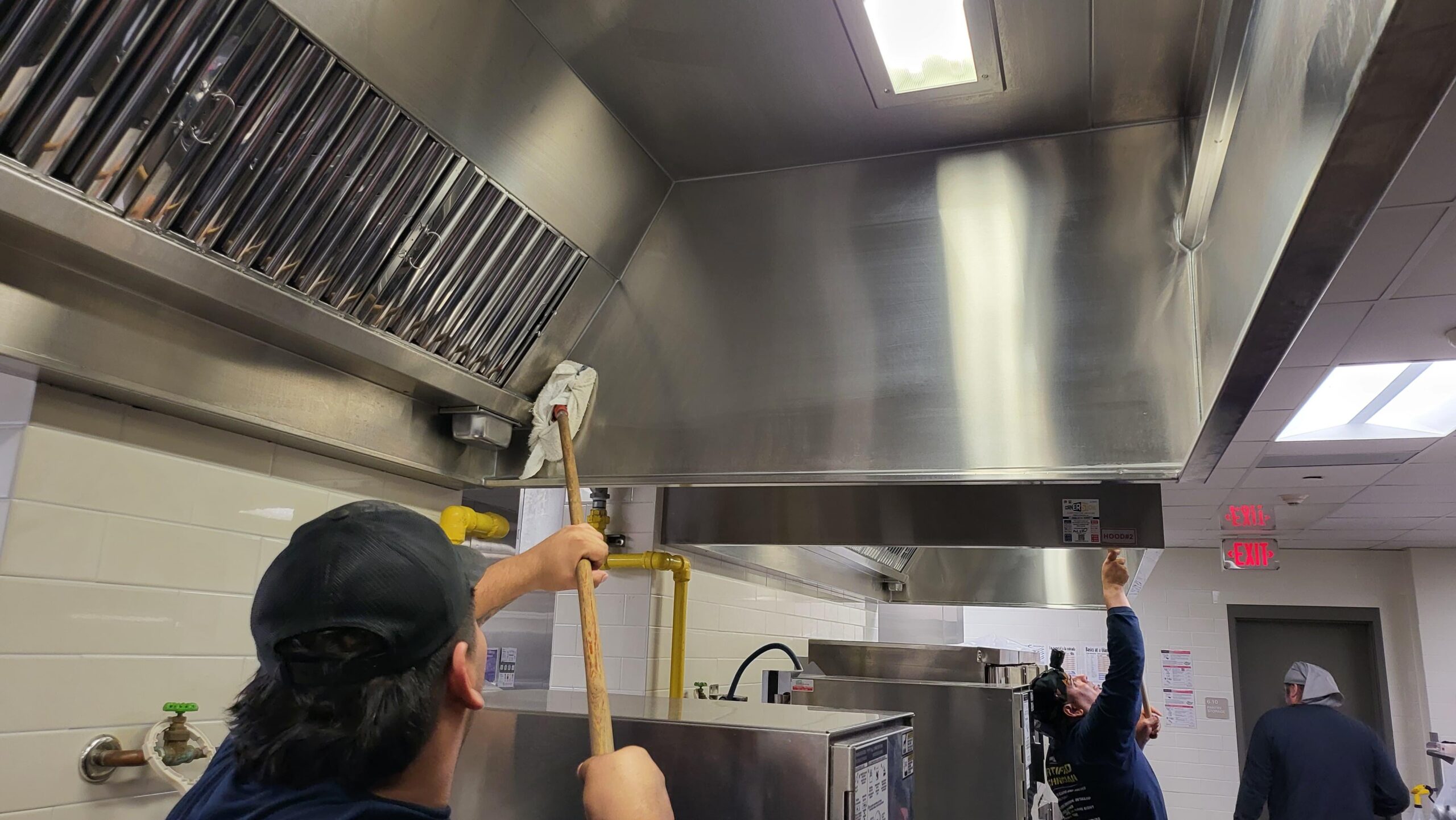
A restaurant’s exhaust system works continuously to remove heat, smoke, grease, and airborne cooking byproducts.
Over time, grease can accumulate in the hood and other components of the exhaust system.
That buildup should not be viewed simply as something that makes equipment look dirty.
It is part of the reason commercial kitchen exhaust systems require appropriate inspection, maintenance, and cleaning.
Professional hood and vent cleaning helps address accumulated grease and residue in areas that ordinary kitchen cleaning may not adequately reach.
For high-volume restaurants, busy cafés with cooking operations, catering kitchens, and other food-service facilities, maintaining the exhaust system should be an important part of the overall cleaning strategy.
Inspections Are Not Something to Think About at the Last Minute
One of the worst approaches a restaurant can take is to think:
“We’ll clean everything before the inspector comes.”
Professional facility maintenance should work in the opposite direction.
A restaurant should maintain consistent cleaning and sanitation practices throughout the year.
Houston’s inspection framework evaluates conditions including food preparation and handling, environmental conditions, sanitation practices, and other aspects of restaurant operations. The city also conducts re-inspections when previous violations require correction, and complaints from restaurant patrons can trigger investigations.
That means businesses should not think of an inspection as a single event.
Instead, they should build an operation that is inspection-ready as part of normal business.
Small Problems Can Become Expensive Problems
Poor maintenance does not necessarily become expensive overnight.
It can start with something small.
A little grease buildup.
A neglected filter.
A difficult-to-reach surface that hasn’t been cleaned properly.
A floor that continually collects grease.
An area behind equipment that employees cannot easily access.
Then the problem grows.
Eventually, a business may have to deal with additional cleaning, corrective work, equipment maintenance, operational disruption, or regulatory consequences.
Houston’s published municipal fine schedule, for example, has included fines for food-establishment violations such as failure to control insects or rodents, failure to keep food free from contamination, improper food temperatures, and failure to display required permits.
The exact consequences of a violation depend on the nature of the violation and the applicable regulations.
But the larger lesson is simple:
Preventive cleaning is generally a smarter business strategy than waiting until a problem becomes urgent.
Commercial Cleaning Is About More Than Passing an Inspection
There is another important point.
A restaurant should not clean only because an inspector might arrive.
It should clean because customers deserve a safe and well-maintained environment.
Employees deserve a cleaner workplace.
Owners want to protect their investment.
Managers want fewer operational surprises.
And the business wants customers to leave with a positive impression.
Passing an inspection is important, but it should be the baseline—not the ultimate goal.
The real goal is to create a consistently maintained food-service environment.
Equipment Cleaning Can Protect Your Investment
Commercial kitchen equipment is expensive.
Ovens, grills, fryers, ranges, refrigeration systems, ventilation equipment, preparation surfaces, and other systems represent significant investments for restaurant owners.
Grease and food residue are unavoidable parts of cooking.
Allowing buildup to remain unchecked, however, can contribute to maintenance problems and make future cleaning more difficult.
Regular professional cleaning helps businesses take a preventive approach.
Instead of waiting until equipment becomes heavily contaminated, restaurant operators can establish recurring cleaning schedules based on the facility’s cooking volume, equipment, operating hours, and specific needs.
Why Choosing the Right Commercial Cleaning Company Matters
Not every cleaning company is equipped to handle a commercial kitchen.
There is a major difference between cleaning an office and cleaning a restaurant kitchen.
A professional commercial kitchen cleaning provider should understand the unique conditions of food-service environments and have appropriate processes for handling grease, exhaust systems, floors, equipment, high-touch surfaces, and difficult-to-access areas.
When evaluating a cleaning company, restaurant owners should ask:
Does the company have commercial kitchen experience?
Restaurant environments require different cleaning methods from ordinary offices or homes.
Does the company understand hood and exhaust cleaning?
Kitchen exhaust systems require specialized attention and should be cleaned according to the appropriate requirements for the facility.
Does the company provide detailed cleaning?
A quick surface-level cleaning is not the same as a comprehensive commercial kitchen cleaning service.
Can the cleaning schedule work around restaurant operations?
Restaurants cannot always shut down during business hours. Professional cleaners should be able to coordinate service around the operation whenever possible.
Does the company understand the importance of documentation?
Good records can help businesses maintain organized cleaning schedules and demonstrate that preventive maintenance is being taken seriously.
Does the company understand Houston-area businesses?
Local knowledge can be valuable because businesses need a cleaning partner who understands the operating realities of Houston’s restaurants, cafés, catering facilities, and commercial kitchens.
Reviews Can Work for You or Against You
There is a powerful connection between professional cleaning and online reputation.
Imagine two restaurants with similar menus, prices, and locations.
Restaurant A has reviews saying:
“Great food, but the restaurant looked dirty.”
Restaurant B has customers consistently commenting:
“Very clean restaurant.”
Which one would a new customer feel more comfortable trying?
The food may be identical.
The difference may be perception.
And perception matters.
In the current digital environment, cleanliness can become part of the brand.
A customer may never see the commercial kitchen, but they can certainly see the results of poor maintenance in the dining room, restrooms, floors, windows, entrances, and other customer-facing areas.
The New Generation Expects Transparency
Today’s customers have more information than previous generations ever had.
They can compare restaurants instantly.
They can look at ratings.
They can read hundreds or thousands of reviews.
They can see photographs from other customers.
They can share their own experiences within minutes.
That creates a new standard for restaurant operators.
You cannot simply tell customers that your business is clean. Your operation has to consistently demonstrate it.
Cleanliness should be visible in the customer experience and supported behind the scenes through professional cleaning and maintenance.
Houston Restaurants Should Think Preventively
The smartest approach is to stop thinking of commercial cleaning as an emergency service.
Instead, think about it as preventive maintenance.
A restaurant should have a plan for:
- Daily cleaning
- Routine sanitation
- Deep cleaning
- Hood and exhaust maintenance
- Floor cleaning
- Equipment cleaning
- Hard-to-reach areas
- High-touch surfaces
- Restrooms
- Exterior areas
- Periodic professional cleaning
- Inspection preparation
- Documentation and scheduling
The exact frequency should depend on the facility and its operations.
A high-volume kitchen may need a different schedule from a small café.
A bakery may have different cleaning priorities from a steakhouse.
A catering kitchen may require different procedures from a hotel kitchen.
The best commercial cleaning program is the one designed around the actual business.
Cleanliness Is Now Part of the Brand
Restaurant owners invest heavily in their brand.
They choose logos.
They design menus.
They create websites.
They run social media campaigns.
They photograph their food.
They spend money attracting customers.
But all of that can be undermined by a customer walking into an environment that appears neglected.
Cleanliness should therefore be viewed as another part of the brand experience.
When customers see a well-maintained restaurant, clean floors, clean restrooms, clean customer areas, and an obviously well-run environment, it reinforces confidence.
When they see the opposite, the damage can happen immediately.
The Bottom Line for Houston Restaurant and Café Owners
Houston’s food-service industry is competitive.
Customers have choices.
Reviews matter.
Inspections matter.
Food safety matters.
Employee safety matters.
Equipment maintenance matters.
And reputation matters.
That is why professional commercial cleaning should not be treated as an expense that can be postponed whenever business gets busy.
It is part of protecting the business.
From commercial kitchen deep cleaning and hood and vent cleaning to floors, equipment, high-traffic areas, and exterior pressure washing, a comprehensive cleaning strategy can help restaurants and cafés maintain a more professional and consistently maintained environment.
The goal is not simply to prepare for the next inspection.
The goal is to make sure that when a customer walks through the door today, tomorrow, or six months from now, the business is ready to make a great impression.
Finding the Right Commercial Cleaning Partner in Houston
For Houston-area restaurants, cafés, catering operations, hospitality businesses, and commercial kitchens, selecting the right cleaning partner can make a meaningful difference.
A company such as Cornerstone Commercial Services can be considered when looking for professional commercial cleaning support, including commercial kitchen deep cleaning, hood and vent cleaning, and power washing services.
The most important thing is to choose a provider that understands that restaurant cleaning is not simply about making surfaces shine.
It is about cleanliness, consistency, prevention, professionalism, reputation, and protecting the operation.
Because in today’s Houston restaurant industry, customers are watching, reviews are influencing decisions, and inspections are part of doing business.
A clean kitchen isn’t just good housekeeping. It’s good business
Absolutely. A good vs. bad commercial kitchen cleaning comparison is a strong blog topic because it lets you educate restaurant owners about what they should actually expect from a professional service rather than simply saying “hire a cleaner.”
For Houston specifically, the topic is especially relevant because the Houston Health Department conducts routine inspections and compliance investigations at restaurants and other food establishments, while Houston’s commercial-cooking requirements also address the maintenance and cleanliness of hoods, ducts, fans, and related exhaust equipment. (Houston Permitting Center)

Comments are closed