


For a restaurant owner, café manager, hotel operator, or commercial kitchen manager, hiring a cleaning company can seem straightforward.
You call a company.
They give you a price.
A crew arrives.
They clean.
And the job is done.
But commercial kitchen cleaning is not that simple.
There is a major difference between professional commercial kitchen cleaning and a quick, inexpensive cleaning service that focuses only on what can be seen.
The difference may not be obvious immediately.
A kitchen can look clean after a few hours of surface-level work while grease, residue, buildup, and contaminants remain in areas that are difficult to reach.
And when it comes to commercial kitchens, the areas that customers cannot see can sometimes be among the most important.
For Houston restaurants and food-service businesses, understanding the difference between good and bad commercial kitchen cleaning can help protect the business from unnecessary maintenance problems, inspection concerns, reputational damage, and potentially serious safety issues.
Good Cleaning vs. Bad Cleaning: The Basic Difference
The easiest way to understand the difference is this:
Bad cleaning focuses on appearance.
Good commercial cleaning focuses on the entire operating environment.
A poor cleaning service may wipe down visible surfaces, mop the floor, clean the hood exterior, and leave.
A professional commercial kitchen cleaning service should look deeper.
It should consider the equipment, grease accumulation, ventilation system, floors, hard-to-reach areas, buildup, scheduling requirements, and the specific needs of the kitchen.
The objective is not simply to make the kitchen look cleaner.
The objective is to create a more thoroughly maintained, safer, and consistently clean commercial environment.
Good Commercial Kitchen Cleaning vs. Bad Cleaning
| Good Commercial Kitchen Cleaning | Bad Commercial Kitchen Cleaning |
| Looks beyond visible surfaces | Focuses mainly on what customers can see |
| Uses commercial-grade equipment and appropriate cleaning methods | Uses basic household-style tools for everything |
| Addresses grease and heavy buildup properly | Wipes over grease without removing the buildup |
| Includes appropriate hood and exhaust-system cleaning | Cleans only the visible outside of the hood |
| Reaches difficult areas | Avoids areas behind, under, or above equipment |
| Uses a structured cleaning process | Has no consistent process |
| Works around restaurant operating hours | Disrupts the business unnecessarily |
| Provides clear service records when appropriate | Leaves little or no documentation |
| Builds a recurring maintenance schedule | Waits until the kitchen becomes visibly dirty |
| Understands commercial kitchen requirements | Treats a commercial kitchen like an ordinary room |
| Protects equipment and surrounding surfaces during cleaning | Creates unnecessary mess or potential equipment damage |
| Focuses on long-term maintenance | Focuses on completing the cheapest possible job |
That difference can have a major impact on a restaurant’s operation.
1. Good Cleaning Goes Beyond What the Customer Can See
A restaurant’s dining area may look spotless while the kitchen has significant buildup in areas customers never see.
Professional commercial kitchen cleaning should consider areas such as:
- Cooking equipment
- Exhaust hoods
- Filters
- Ductwork
- Exhaust fans
- Walls around cooking equipment
- Floors and grout
- Areas behind and underneath equipment
- Drains
- Hard-to-reach surfaces
- Storage and service areas
A cleaning company that only wipes visible surfaces is not providing the same service as a company that understands the entire commercial kitchen environment.
The difference is especially important when dealing with grease.
Grease can accumulate gradually, and once it becomes heavily established, it can be much more difficult to remove.
2. Good Hood Cleaning Is Not Just Making the Hood Shine
One of the biggest mistakes restaurant operators can make is assuming that a shiny hood means the exhaust system has been properly cleaned.
It doesn’t.
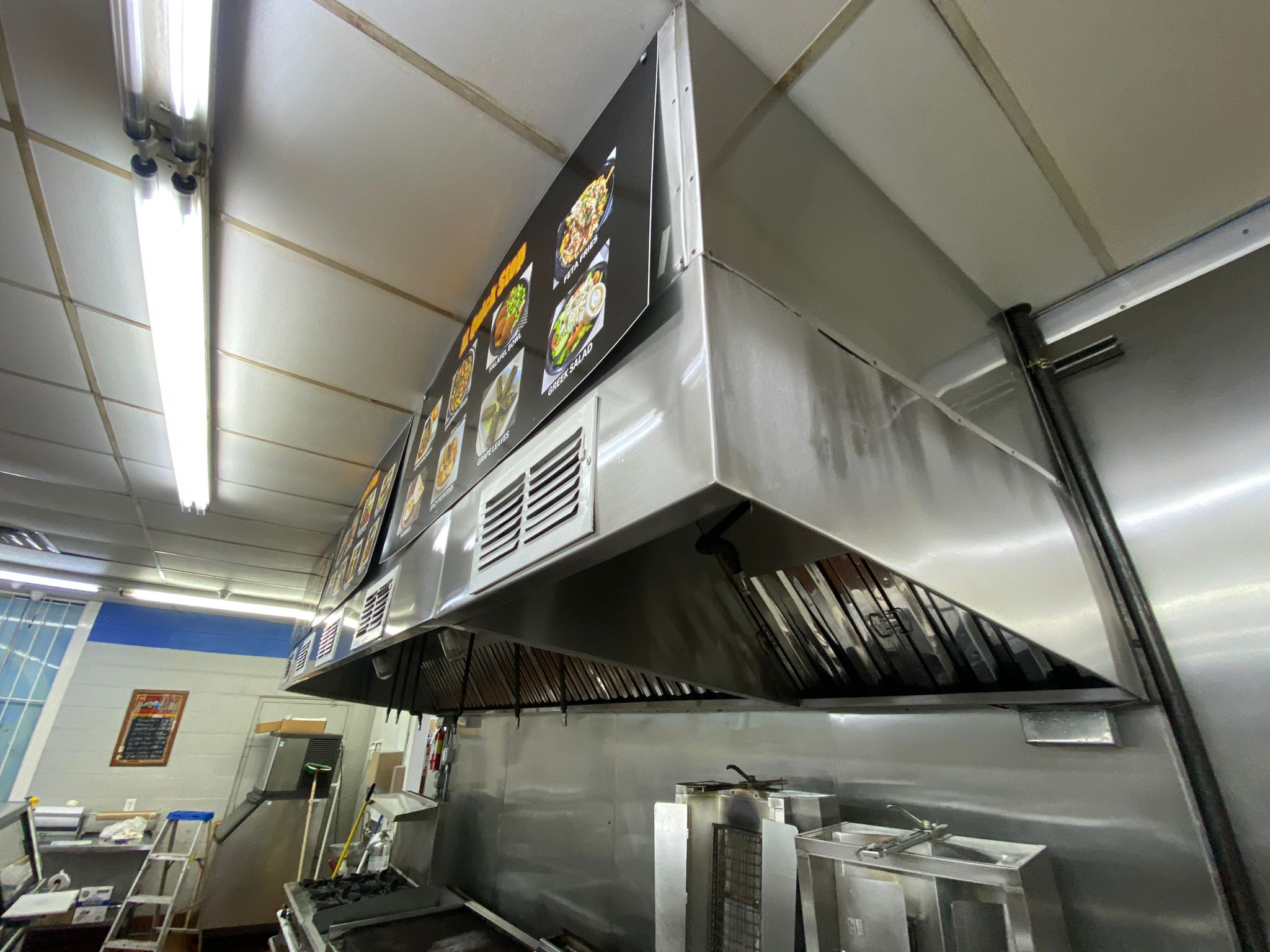
Commercial kitchen exhaust systems can include the hood, filters, plenums, ductwork, fans, and other components.
Houston’s adopted building requirements reference NFPA 96 provisions for commercial cooking exhaust systems and state that cooking equipment, hoods, ducts, fans, fire-suppression systems, and related equipment must be maintained appropriately; they also place responsibility for cleanliness and maintenance of the ventilation and fire-protection system on the system owner unless that responsibility has been transferred in writing. (Houston Permitting Center)
That is why professional hood and exhaust cleaning should not be reduced to:
“Make the hood look clean.”
The real question is:
“Has the appropriate portion of the exhaust system actually been cleaned and maintained?”
A good cleaning provider understands that distinction.
3. Bad Cleaning Can Hide the Problem
Imagine a hood that is covered in grease.
A poor cleaning company may spray the visible surface, wipe it down, and make it look significantly better.
From the kitchen floor, the hood may appear clean.
But what about the areas that were not addressed?
If grease remains inside relevant exhaust components, the kitchen may still have a maintenance and fire-safety concern.
This is one reason professional cleaning should be evaluated based on what was actually cleaned, not simply how shiny something looks afterward.
4. Good Cleaning Uses the Right Equipment
Commercial kitchens are demanding environments.
Heavy grease, carbonized residue, food particles, oil, and buildup can require specialized cleaning methods.
Professional commercial cleaning may involve appropriate degreasers, pressure-washing equipment, scraping tools, protective coverings, specialized brushes, and other equipment depending on the surface and service being performed.
The right approach depends on the job.
Using the strongest chemical or highest pressure is not automatically better.
Professional cleaning means understanding:
What needs to be cleaned → what it is made of → what buildup is present → what method is appropriate → how to protect the surrounding equipment.
That’s where experience matters.
5. Good Cleaners Protect the Kitchen While They Work
A commercial kitchen contains expensive equipment.
Refrigeration units, ovens, fryers, grills, preparation equipment, electrical components, flooring, walls, and other systems all need to be considered during a deep cleaning.
A professional crew should take reasonable precautions to protect equipment and surrounding areas during the cleaning process.
That can include covering sensitive equipment and surfaces, controlling water and cleaning solutions, and properly cleaning up after the service.
A cleaning job should leave the kitchen cleaner—not create a second maintenance problem.
6. Good Cleaning Is Scheduled. Bad Cleaning Is Reactive.
One of the biggest differences between professional maintenance and poor maintenance is consistency.
A restaurant shouldn’t wait until the kitchen looks terrible before arranging professional cleaning.
Instead, cleaning should be incorporated into an ongoing maintenance program.
The appropriate frequency will depend on the type of kitchen, cooking volume, equipment, operating schedule, and applicable requirements.
Different kitchens have different needs.
A busy high-volume restaurant is not the same as a small café.
A steakhouse is not the same as a bakery.
A hotel kitchen is not the same as a catering operation.
A professional provider should help establish a schedule based on the actual operation rather than applying the exact same schedule to every customer.
7. Good Cleaning Helps Restaurants Stay Prepared for Inspections
Houston’s Food Safety and Inspection Program conducts routine inspections and compliance investigations at retail food establishments and other specialized food establishments, including restaurants, mobile food units, wholesale food facilities, and catering businesses. (Houston Permitting Center)
Houston has also moved toward risk-based food-safety violation categories—Priority, Priority Foundation, and Core—as part of its updated inspection framework. (Houston Health Department)
That makes a consistent cleaning program even more important.
But there is an important distinction:
A cleaning company cannot guarantee that a restaurant will pass a health or fire inspection.
Inspections evaluate many aspects of an operation, including food handling, employee practices, equipment, facility conditions, sanitation, and other requirements.
Professional cleaning is one component of a broader compliance and food-safety program.
The smart approach is to keep the facility consistently maintained rather than attempting a frantic cleanup immediately before an inspection.
8. Bad Cleaning Often Means “Cheapest Price Wins”
Price matters to every business owner.
But commercial kitchen cleaning should not be evaluated solely on the lowest quote.
Suppose one company quotes $500 and another quotes $900.
At first glance, the $500 service may look like the better deal.
But what exactly does each company include?
Does one clean the entire exhaust system while the other only cleans the visible hood?
Does one provide documentation?
Does one protect equipment properly?
Does one clean difficult areas?
Does one use trained commercial kitchen technicians?
Does one offer recurring maintenance?
Does one actually understand the specific requirements of commercial kitchens?
The cheapest quote can become expensive if the work has to be repeated or if neglected areas create additional maintenance or compliance problems.
The better question is not “Who is cheapest?”
It is:
“Who provides the most appropriate service for my kitchen?”
9. Good Cleaning Includes Clear Communication
A professional cleaning company should be able to explain what it is going to clean.
Restaurant managers should not have to guess.
Before hiring a provider, ask:
- What exactly is included?
- Is the hood being cleaned?
- Are filters included?
- Is ductwork included when applicable?
- Is the exhaust fan included?
- Are floors included?
- Are walls included?
- Are equipment exteriors included?
- What areas are excluded?
- How long will the service take?
- Can the work be completed after hours?
- Will the kitchen need to be shut down?
- What documentation will be provided?
Clear communication prevents misunderstandings.
10. Good Cleaning Creates Documentation
For commercial operations, documentation can be valuable.
Depending on the service, a professional provider may provide service records, photographs, reports, tags, or other documentation showing when work was completed.
This creates a record for the restaurant’s internal maintenance program and can be useful when coordinating with property managers, insurers, or authorities having jurisdiction where applicable.
The important thing is that documentation should reflect work actually performed.
A sticker alone does not prove that an exhaust system was thoroughly cleaned.
The quality of the work comes first.
11. Good Cleaning Protects the Restaurant’s Reputation
Today’s restaurant customer is different.
Before visiting a restaurant, customers can check Google reviews, social media, photos, videos, and comments from other customers.
And cleanliness frequently becomes part of those conversations.
A restaurant might receive dozens of positive reviews about its food and service.
Then one customer posts:
“The restaurant was dirty.”
Another says:
“The bathroom was filthy.”
Another comments:
“The kitchen looked greasy.”
Those comments can influence potential customers who have never even visited the restaurant.
That means commercial cleaning is not just about the back-of-house operation.
It can influence customer trust and brand reputation.
12. Bad Cleaning Can Create a False Sense of Security
This may be the most dangerous difference of all.
A bad cleaning job can make a restaurant owner believe everything is fine.
The hood looks shiny.
The floors look better.
The kitchen smells cleaner.
Everyone assumes the problem is solved.
But if important areas were never properly addressed, the business may simply have a cleaner-looking problem.
Professional cleaning should provide confidence based on a thorough process—not merely a good-looking result.
What Should Restaurant Owners Look for in a Good Commercial Cleaning Company?
Before choosing a commercial kitchen cleaning provider in Houston, look for a company that demonstrates:
Restaurant environments are specialized. Look for experience with commercial food-service facilities.
Specialized Hood and Exhaust Knowledge
The provider should understand that commercial exhaust cleaning involves more than wiping the visible hood.
The company should have equipment and cleaning methods appropriate for commercial kitchens.
Ask about technician experience, training, and safety procedures.
You should know exactly what you are paying for.
The service should work around your restaurant’s operating schedule whenever possible.
Ask what records or service documentation are provided.
A good provider should be able to discuss ongoing cleaning rather than only emergency or one-time services.
Look for clear communication, punctuality, proper protection of the facility, and a consistent process.
A Simple Test: Ask These Five Questions
Before hiring a commercial kitchen cleaning company, ask:
1. What exactly will you clean?
2. Do you clean the entire exhaust system or only the visible hood?
3. How do you protect my equipment during cleaning?
4. What documentation do I receive after the service?
5. Can you recommend a recurring cleaning schedule based on my kitchen?
The answers can tell you a great deal about whether you are talking to a professional commercial kitchen cleaning provider or simply a general cleaning company.
Good Commercial Cleaning Is an Investment, Not Just an Expense
Restaurant owners are constantly looking at expenses.
Labor.
Food.
Rent.
Utilities.
Insurance.
Equipment.
Maintenance.
Cleaning.
It is natural to look for ways to control costs.
But professional commercial kitchen cleaning should be considered part of preventive maintenance and operational risk management, not simply another janitorial expense.
A properly maintained kitchen can be easier to manage, more pleasant for employees, more professional for customers, and better prepared for routine inspections and maintenance requirements.
And when a business operates thousands of hours a year, prevention can be far more practical than constantly reacting to problems.
The Bottom Line: Good Cleaning vs. Bad Cleaning
The difference between good and bad commercial kitchen cleaning is not always visible immediately.
Both companies may arrive with cleaning equipment.
Both may leave the kitchen looking better.
Both may give you an invoice.
But the quality of the process can be dramatically different.
Bad cleaning asks: “Does it look clean?”
Good cleaning asks: “Has the kitchen actually been properly maintained?”
For Houston restaurants, cafés, hotels, catering kitchens, corporate cafeterias, and other commercial food-service operations, that distinction matters.
Your cleaning provider should understand grease, exhaust systems, equipment, floors, difficult-to-reach areas, scheduling, documentation, and the realities of operating a commercial kitchen.
Most importantly, they should understand that the job is not finished simply because the visible surfaces look better.
Choosing a Professional Commercial Cleaning Partner in Houston
When selecting a commercial cleaning company, look for a provider that combines experience, appropriate equipment, detailed processes, reliable scheduling, and a genuine understanding of commercial kitchen environments.
Cornerstone Commercial Services is one Houston-area option for businesses seeking commercial cleaning support, including commercial kitchen deep cleaning, hood and vent cleaning, and power washing.
The right cleaning partner should not simply help your kitchen look clean.
They should help you build a consistent, professional, preventive cleaning program that supports the long-term operation of your business.
Because in a commercial kitchen, the difference between good cleaning and bad cleaning isn’t just about appearance.
It’s about what happens after the cleaning crew leaves.

Comments are closed