


Houston’s restaurant and food-service industry is changing quickly.
From independent cafés and neighborhood restaurants to large hospitality groups, catering operations, corporate cafeterias, and institutional kitchens, food businesses are facing a new kind of expectation. Customers want cleaner environments. Employees expect safer workplaces. Operators need to protect expensive equipment. And health, sanitation, fire-safety, and operational standards are becoming increasingly important.
As a result, commercial cleaning is no longer simply a task that happens after the kitchen closes.
It has become an important part of restaurant operations, food safety, customer experience, equipment maintenance, workplace safety, and brand reputation.
The commercial cleaning industry itself is evolving alongside these expectations. Technology, sustainability, specialized equipment, documentation, and more sophisticated cleaning programs are changing how professional facilities are maintained. Industry organizations are highlighting trends such as robotics, proof of service, data analytics, smart cleaning technology, and sustainability as important parts of the industry’s future.
For Houston businesses, these changes are particularly relevant.
Houston’s Food-Service Industry Requires a Different Approach to Cleaning
Houston is a massive and diverse market for restaurants and food-service businesses. Its dining scene includes everything from fast-casual restaurants and coffee shops to fine dining, hotels, catering companies, hospitals, corporate dining facilities, and large institutional kitchens.
Every one of these environments has different cleaning requirements.
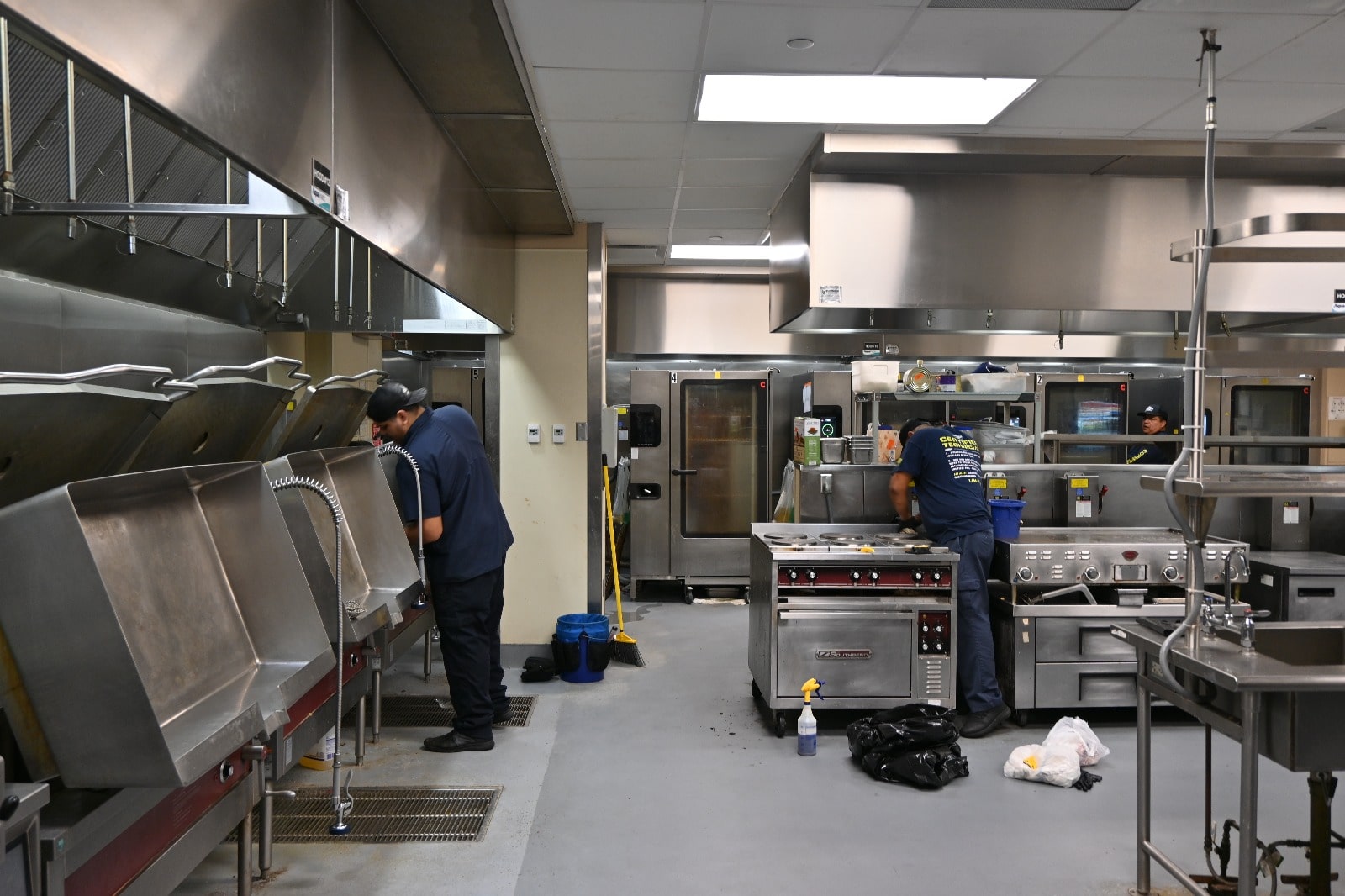
A small café may have a compact kitchen operating continuously throughout the day. A busy restaurant may have multiple cooking stations, fryers, ovens, grills, exhaust systems, grease-producing equipment, dining areas, and high-traffic floors. A hotel or institutional kitchen may serve hundreds or even thousands of meals and require carefully coordinated cleaning schedules.
This is why commercial kitchen cleaning cannot simply be treated as larger-scale house cleaning.
Professional food-service environments have specialized risks and specialized cleaning requirements.
Grease accumulates differently from ordinary dirt. Exhaust systems require specialized attention. Floors can become slippery from oils and food residue. Drains can collect organic material. High-touch surfaces require regular attention. Equipment can lose efficiency when buildup is allowed to accumulate.
The goal is not simply to make a kitchen look clean.
The goal is to create an environment that is cleaner, safer, more efficient, easier to maintain, and prepared for professional scrutiny.
Cleaning Is Becoming Part of Restaurant Risk Management
One of the biggest changes in commercial cleaning is the shift from reactive cleaning to preventive maintenance.
In the past, a business might call a cleaning company when an area became visibly dirty.
Today, smart operators increasingly think about cleaning differently.
They ask:
- How frequently does this area actually need to be cleaned?
- Where does grease accumulate fastest?
- Which surfaces require specialized treatment?
- How can cleaning be performed without disrupting service?
- How can equipment be protected?
- How can cleaning activities be documented?
- Are staff members spending too much time on tasks that could be professionally handled?
- What cleaning problems could eventually become safety, maintenance, or operational problems?
This approach turns cleaning into part of a broader facility-management strategy.
Regular professional cleaning can help prevent small maintenance issues from becoming larger and more expensive problems.
Restaurant Inspections: Cleanliness Should Never Be a Last-Minute Project
For restaurant owners and managers, inspections can create enormous pressure.
But an inspection-ready kitchen should not be something a business tries to create the night before an inspector arrives.
It should be the result of a consistent cleaning and maintenance program.
Cleaning schedules, sanitation procedures, equipment maintenance, employee practices, and professional deep cleaning all contribute to maintaining a food-service environment that is prepared for routine regulatory oversight.
Texas food-service businesses operate within food-safety requirements administered through state and local regulatory systems, so restaurant operators should always understand the requirements applicable to their particular facility and jurisdiction.
Professional cleaning does not replace food-safety procedures or regulatory compliance. Instead, it can become an important component of a restaurant’s broader operational system.
That distinction matters.
A clean-looking kitchen and a properly maintained commercial kitchen are not always the same thing.
Professional cleaning should address the areas that routine staff cleaning may not have the time, equipment, or expertise to handle thoroughly.
The Areas Customers Don’t See Can Be the Most Important
Customers typically notice the dining room first.
They see the floors, tables, windows, entrance, counters, and restrooms.
But some of the most important cleaning work happens where customers rarely look.
Think about:
- Exhaust hoods
- Hood filters
- Ductwork
- Fans
- Grease-producing equipment
- Behind and underneath equipment
- Floors and grout
- Floor drains
- Walls near cooking stations
- High and difficult-to-reach surfaces
- Storage areas
- Waste-management areas
These locations can accumulate grease, carbon, food residue, moisture, and other buildup over time.
This is one reason specialized commercial kitchen cleaning is different from ordinary janitorial service.
A professional cleaning program should consider the entire kitchen environment, not only the surfaces that are immediately visible.
Hood and Exhaust Cleaning Is About More Than Appearance
Commercial kitchen exhaust systems are particularly important because cooking produces grease and airborne contaminants that can accumulate within ventilation components.
Over time, buildup can affect airflow and create additional maintenance and safety concerns.
That makes professional hood and exhaust-system cleaning an important part of commercial kitchen maintenance.
The objective is not simply to make the hood look shiny.
It is to address grease buildup in the components of the ventilation system according to the appropriate cleaning requirements and schedule for the facility.
For restaurants that operate heavy cooking equipment every day, this can be especially important.
Why Gen Z Is Changing Expectations Around Clean Businesses
There is another major shift happening that restaurant operators should not ignore: the changing expectations of younger consumers and employees.
Gen Z has grown up in an environment where information is immediate.
People can search for a restaurant before visiting it. They can look at photographs. They can read reviews. They can watch videos. They can see customer comments on social media. They can share experiences instantly.
That means cleanliness is increasingly part of the public perception of a brand.
A restaurant can have outstanding food, but a dirty dining room, unpleasant restroom, greasy entrance, or visibly neglected environment can undermine the entire experience.
Younger consumers are also increasingly familiar with conversations surrounding sustainability, wellness, transparency, and responsible business practices.
That does not mean every customer expects a restaurant to operate perfectly.
It means expectations are changing.
Cleanliness is becoming part of the customer experience not merely a behind-the-scenes operational requirement.
Sustainability Is Becoming Part of Commercial Cleaning
Another important evolution is the growing interest in environmentally responsible cleaning.
Food-service businesses are increasingly evaluating not only whether something is clean, but also how it is being cleaned.
The commercial cleaning industry is responding with greater interest in:
- More efficient equipment
- Reduced water consumption
- Responsible chemical use
- Concentrated cleaning products
- Refillable systems
- Better waste management
- Energy-efficient equipment
- Sustainable product sourcing
Foodservice cleaning research has also identified sustainability as an increasingly important consideration when businesses choose cleaning products and services.
The objective should not be to choose a product simply because it is labeled “green.”
The better approach is to evaluate whether cleaning methods are effective, appropriate for the surface, safe for the environment and people using the facility, and practical for the operation.
Technology Is Changing Commercial Cleaning
The commercial cleaning industry is also becoming more technology-driven.
Robotic floor-cleaning equipment, digital scheduling, service documentation, data analytics, automated reporting, and other technologies are beginning to influence how commercial cleaning companies operate.
Industry experts have identified robotics, proof of service, and data analytics among the emerging developments shaping the future of professional cleaning.
For restaurant operators, the most valuable technology may not necessarily be a robot.
Sometimes it is simply better information.
Knowing when a service was performed, what areas were addressed, what was discovered, and when the next service is recommended can make facility maintenance more organized and predictable.
That creates a transition from:
“We think it was cleaned recently.”
to:
“We know when it was cleaned, what was completed, and what needs attention next.”
That difference becomes increasingly valuable as restaurant operations become more sophisticated.
Professional Cleaning Can Also Protect Equipment
Commercial kitchen equipment represents a significant investment.
Fryers, ovens, grills, ranges, refrigeration systems, ventilation components, and other equipment operate under demanding conditions every day.
Grease and food residue are unavoidable byproducts of cooking but allowing excessive buildup to remain for long periods can contribute to maintenance problems.
Routine cleaning and preventive maintenance can help keep equipment and surrounding areas in better operating condition.
Professional cleaning should therefore be viewed not only as a sanitation expense, but also as part of protecting the physical assets of a commercial kitchen.
The Future Is Not “Clean More.” It Is “Clean Smarter.”
Perhaps the biggest change in commercial cleaning is the move toward smarter cleaning programs.
More cleaning is not automatically better.
The right cleaning frequency depends on the type of facility, volume of cooking, equipment, operating hours, traffic, surfaces, grease production, and applicable requirements.
A modern cleaning program should therefore be customized.
For one restaurant, the priority may be heavy grease accumulation around cooking equipment.
For another, it may be exhaust-system maintenance.
For a café, floors, drains, customer-facing surfaces, and high-touch areas may receive greater attention.
For a hotel or institutional kitchen, the scale and complexity may require a much more structured maintenance program.
There is no one-size-fits-all commercial kitchen.
And there should not be a one-size-fits-all cleaning plan.
What Houston Restaurant Owners Should Look for in a Commercial Cleaning Partner
As the industry evolves, choosing a commercial cleaning company should involve more than comparing the lowest price.
Restaurant and facility managers should consider:
Does the company understand commercial kitchens, restaurants, cafés, hospitality environments, and food-service operations?
Does the provider have a structured approach rather than simply sending a crew in with basic cleaning supplies?
Can cleaning happen around operating hours and minimize disruption to the business?
Does the provider have appropriate equipment and methods for grease, floors, exhaust systems, difficult-to-reach areas, and heavy buildup?
Can the business clearly document completed services and maintain an organized cleaning schedule?
Does the cleaning process account for employees, food-contact areas, equipment, ventilation, and the specific environment being cleaned?
Does the provider understand the unique operating environment of Houston-area restaurants and businesses?
These questions can help a business evaluate cleaning providers based on long-term value rather than simply the initial quote.
Houston’s Commercial Cleaning Industry Is Moving Forward
The commercial cleaning industry is entering a more sophisticated era.
Cleaning companies are becoming more specialized. Technology is improving consistency and documentation. Sustainability is influencing purchasing decisions. Consumers are paying closer attention to cleanliness. Restaurant operators are becoming more aware of preventive maintenance. And commercial kitchens are expected to maintain increasingly high standards.
For Houston’s restaurants, cafés, hotels, catering operations, corporate kitchens, and institutional food-service facilities, this means cleaning should be considered an essential part of the business not an afterthought.
A professionally maintained kitchen can contribute to a safer working environment, better operational consistency, stronger customer impressions, and a facility that is better prepared for inspections and routine maintenance.
And as Houston continues to grow and its food-service industry continues to evolve, the businesses that treat cleanliness as part of their brand and operational strategy will be better positioned to meet changing expectations.
Choosing the Right Commercial Cleaning Support in Houston
For businesses looking for specialized commercial kitchen cleaning in the Houston area, Cornerstone Commercial Services focuses on commercial kitchen environments, including kitchen deep cleaning, hood and vent cleaning, and commercial power washing.
The company’s current service offering is specifically structured around restaurants and cafés as well as hotels, catering kitchens, corporate food-service environments, and healthcare facilities.
For a restaurant or commercial kitchen, the objective should always be the same: maintain a cleaner, safer, more professional environment while allowing the business to focus on serving its customers.
As commercial cleaning continues to evolve, that standard will only become more important.
The future of commercial cleaning is not simply about making a building look clean.
It is about health, safety, prevention, efficiency, technology, sustainability, reputation, and operational confidence.
For Houston’s food-service industry, professional cleaning is becoming part of the infrastructure behind a successful business.
And in an era where customers can see, review, photograph, and share almost everything, maintaining that standard has never mattered more.

Comments are closed